
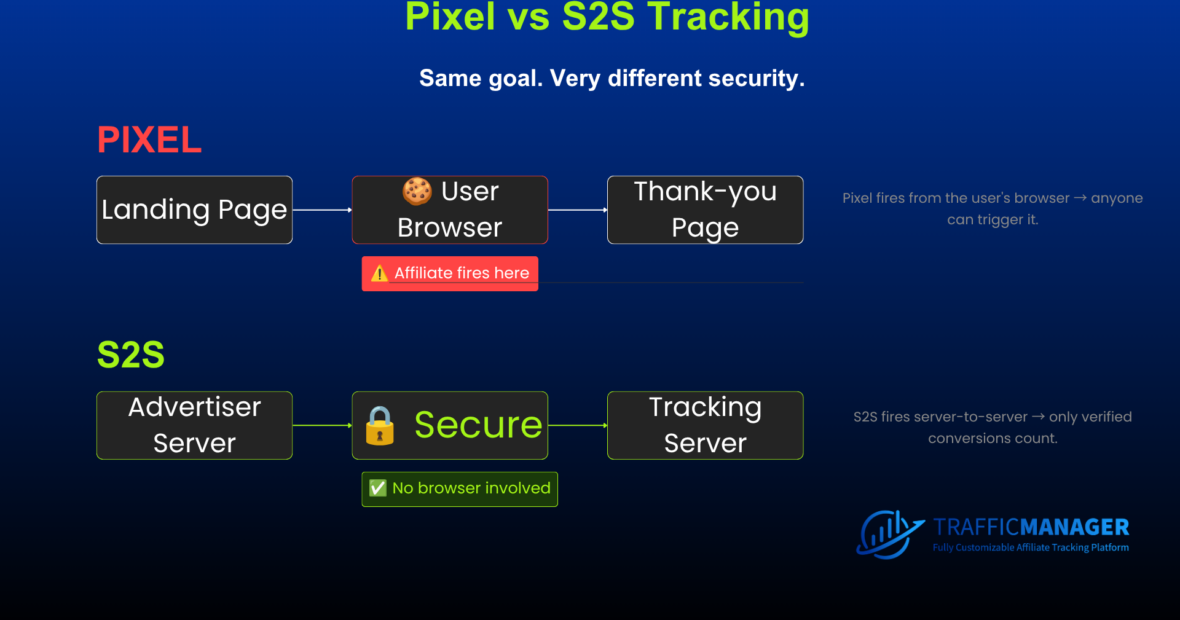
Pixel tracking and S2S postback tracking are often presented as two equivalent ways of reporting conversions. They are not. Both can report a sale, lead, registration, deposit, or another conversion event, but they rely on very different processes.
Pixel tracking
Pixel tracking works inside the user’s browser. A visitor clicks an affiliate link, the tracking information is stored in a cookie or another browser-based identifier, and a pixel placed on the confirmation page reports the conversion back to the tracking platform.
The main advantage is simplicity. In many cases, the advertiser only needs to place a small piece of code on the website. This makes pixel integrations useful when a fast or technically simple setup is required.
The problem is that the conversion depends on the visitor’s browser.
- The correct page needs to load.
- The tracking request needs to fire.
- The browser must not block the script.
- The click identifier must still be available.
The visitor may also need to complete the conversion in the same browser or on the same device used for the original click. Privacy protections, browser restrictions, ad blockers, deleted cookies, cross-device journeys, and incomplete page loads can all affect the accuracy of the reporting.
The conversion may still exist inside the advertiser’s system while never reaching the affiliate tracking platform. For the advertiser, the order was completed. For the affiliate, the conversion never happened.
Affiliates see a lower conversion rate and EPC than they are actually generating. Advertisers and networks begin comparing different numbers. And when discrepancies become frequent, trust starts to disappear.
There is also a security consideration.
Because the pixel request is exposed on the frontend, it may be inspected and, depending on how the integration is protected, potentially triggered or replayed manually. A properly configured pixel integration can include validation rules and duplicate protection, but a browser-based request will always be more exposed than direct communication between two servers.
S2S (server-to-server) postback tracking
In this case, instead of relying on the visitor’s browser to report the conversion, the advertiser’s backend sends the event directly to the affiliate tracking platform via a postback.
When someone clicks an affiliate link, the tracking platform generates a unique click ID. That click ID is passed to the advertiser, operator, affiliate network, eCommerce platform, or CRM and stored together with the visitor’s order, lead, or account.
When the conversion takes place, the advertiser’s server sends the click ID back through a postback URL, together with other relevant information such as:
- Transaction ID
- Conversion status
- Payout or revenue
- Currency
- Event type
- Lead status, etc.
The affiliate tracking platform then uses the click ID to attribute the conversion to the correct affiliate, offer, campaign, and traffic source.
The visitor’s browser is no longer responsible for reporting the conversion. The thank-you page does not need to remain open. Cookies are not required at the moment the event is sent. The conversion data moves directly from the system where the event was recorded to the tracking platform responsible for the attribution.
This is why S2S postbacks have become the preferred tracking method across most affiliate marketing industries. Postbacks are especially important when conversions have multiple stages because a conversion is not always a single event.
In eCommerce, Cash on Delivery, or nutra, for example, an order may later be confirmed, cancelled, refunded, shipped, or delivered.
In lead generation, a submitted lead may later become approved, rejected, duplicated, or qualified.
In iGaming, the same player can generate multiple events over time:
Registration
First-time deposit
Additional deposits
Turnover
NGR, etc.
These events already exist inside the advertiser’s or operator’s backend. Sending them directly to the affiliate tracking platform through S2S postbacks is more logical and more reliable than trying to reproduce the entire customer lifecycle through browser pixels.
Postbacks also allow the information to move through the complete affiliate chain. The advertiser or operator sends an incoming postback to the affiliate program or network. The tracking platform records the event and can immediately send an outgoing postback to the affiliate or media-buying team. The same conversion remains connected to the same click ID/player ID across the entire flow.
The disadvantage of S2S tracking is that it requires a bit of initial technical setup.
Different platforms usually use different parameter names.
One platform may use {clickid}.
Another may use {subid}.
Another may use {btag}.
Another may use a completely different token format.
This can make the integration look more complicated than it actually is, especially for non-technical people. The logic, however, remains the same:
The tracking platform passes a unique click ID. The receiving platform stores it. When a conversion happens, the click ID is sent back through the postback URL. Both sides test the click and conversion to confirm the integration.
The initial setup may require technical support or a developer, but it is generally a one-time operation per integration. It is not something that needs to be rebuilt every week.
Does this mean pixels are no longer useful? No.
Pixels still have valid use cases. They can be useful for analytics, remarketing, media-buying optimization, advertising-platform signals, or situations where a server-side integration is not available.
TrafficManager supports both pixel and S2S postback integrations because different businesses may require different tracking methods.
However, using a pixel to help optimise a media-buying campaign and using it as the primary source of truth for affiliate commissions are two different things.
When a server-side integration is available, S2S postback tracking should generally be the preferred option.
The real question is not: Which integration is easier to launch today?
The real question is: Which integration can still be trusted when hundreds of affiliates, thousands of conversions, and real money are running through it?
Pixel tracking may be easier to implement, but S2S postback tracking is more accurate, more reliable, more secure, and better suited to affiliate programs and networks that want to scale.
This is why it has become a standard across eCommerce, nutra, lead generation, COD, dating, finance, iGaming, casino, betting, and many other performance-marketing industries.
For a beginner-friendly explanation of how an S2S postback integration works, read our step-by-step guide:
To see how incoming and outgoing postbacks work inside TrafficManager, explore our online demo or schedule a free video call platform presentation HERE