
Here is why custom tracking domains are more than a branding feature in affiliate marketing.
Custom tracking domains are often presented only as a branding feature, but actually they are way more than this for your affiliates. They are also a business continuity tool.
A custom tracking domain is a domain or subdomain owned by the affiliate or affiliate program and connected to the tracking platform. Instead of promoting offers through the generic tracking domain shared by the entire network, the affiliate can generate tracking links using their own domain.
The click passes normally through the same tracking platform. The same attribution rules, offer settings, targeting, reporting, and conversion tracking still apply. The main difference is the domain the final user sees and the level of control the affiliate has over it.
When a shared tracking domain becomes a single point of failure
Sometimes, a traffic source flags or blocks a tracking domain. When that happens, the campaign does not patiently wait for the affiliate manager or the technical team to become available. The affiliate (especially a media buyer) may still be spending money while the traffic is no longer reaching the offer correctly.
The problem becomes even more serious when the same tracking domain is shared across the entire affiliate network.
A domain problem affecting one campaign can potentially affect other affiliates and campaigns using that same domain, even when their traffic and promotional methods are completely different. One shared tracking domain can therefore become a bottleneck and a single point of failure for the whole operation.
If the affiliate has to contact the network and wait for someone to make the change from the back end, configure the new domain, test the setup, and send the updated link back, hours, if not days, can pass.
During that time, the affiliate loses commissions, the network or advertiser loses revenue, and the affiliate advertising budget continues to be spent on an empty page.
Depending on the traffic source, the affiliate may also need to update the campaign, submit the new link for review, and wait for approval (for META campaigns, for example). There is already enough friction in this process. Waiting for the affiliate network to answer a support ticket should not add another layer.
Why affiliate-side domain management matters
This is why TrafficManager allows platform owners to give affiliates permission to add, replace, delete, and manage their own custom tracking domains directly from their dashboard, without waiting for admin intervention.
The platform owner remains in control and decides whether affiliates should have access to this functionality. TrafficManager can also provide public domains managed by the network and made available to all affiliates, while private affiliate domains remain available only to the affiliate who added them. The setup process guides the user through the required DNS configuration.
This does not mean that the link inside a live campaign changes automatically.
The affiliate still needs to update the campaign where necessary and follow the traffic source’s review process. The difference is that the affiliate can react immediately instead of waiting for the network’s support team to complete every step.
No support ticket.No waiting for someone from the technical team to become available. No unnecessary dependency between the affiliate and the network.
For an affiliate spending hundreds or thousands of euros per day, this difference can be very important.
A custom domain is also a branding tool
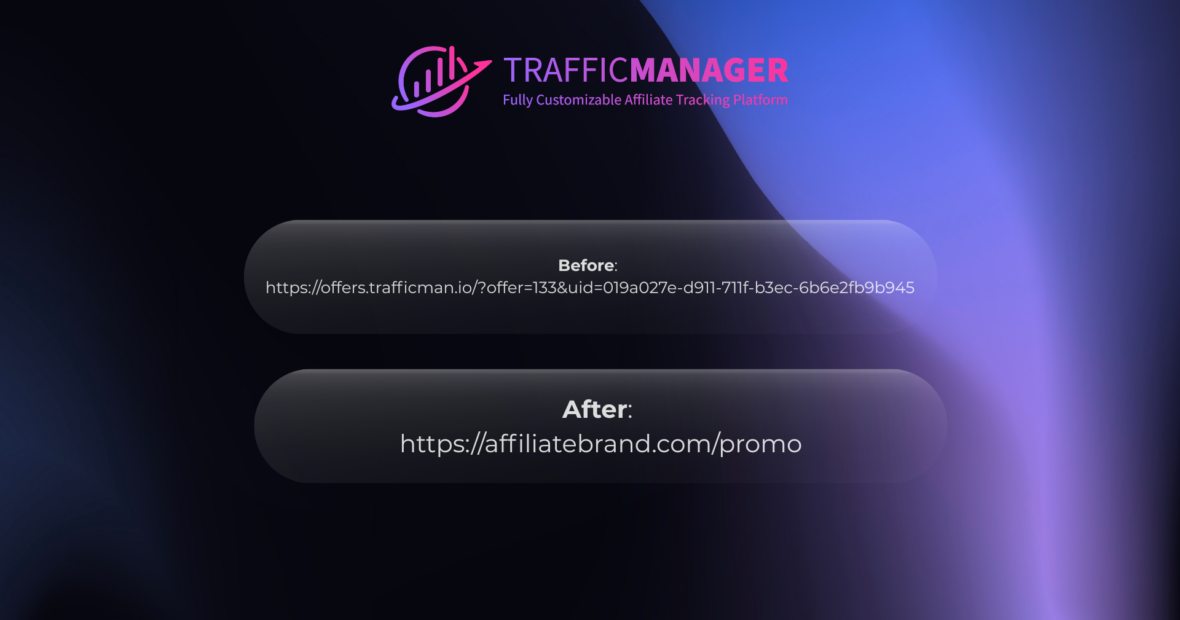
There is another important advantage. Once the custom domain is connected, the affiliate can generate a short tracking link using that domain. Instead of promoting a long, generic tracking URL containing multiple parameters, the affiliate can use a cleaner link under their own domain.
For example, instead of something similar to:
https://tracking-network-domain.com/click?id=123&offer=456&source=789
The affiliate could use:
https://go.affiliatedomain.com/product or even https://affiliatedomain.com/product
The exact structure will depend on the platform and setup, but the benefit is the same: a shorter, cleaner, and more recognisable promotional link.
This can be useful across social media, email, SMS, influencer content, livestreams, podcasts, video descriptions, and even offline promotional channels where a simple and memorable URL matters.
TrafficManager’s Custom Affiliate ShortLinks feature allows affiliates to create simplified tracking URLs under their connected domains, including multiple short-link combinations under the same domain. The feature can also be accessed through the API when the short-link creation process needs to be integrated into another internal workflow.
A custom tracking domain and a custom short link are not exactly the same thing.
The custom domain is the foundation.
The short link is the cleaner promotional URL created under that domain.
Together, they give affiliates more control over how their tracking links are presented and managed.
Two benefits from the same feature
The same feature therefore offers two important benefits:
Business continuity when a tracking domain has a problem.
The affiliate can connect or replace a domain and generate a new tracking link without waiting for the network to handle the entire process.
Cleaner, branded short links for everyday promotion and traffic-source diversification.
The affiliate can promote offers using a domain that is consistent with their brand, website, content, or media-buying operation.
There is also an operational benefit for the affiliate network.
When affiliates can handle approved domain changes themselves, the support and technical teams no longer need to manually process every domain request. This becomes increasingly important for networks working with hundreds or thousands of affiliates.
The network keeps control over the feature, while removing unnecessary manual work from the daily operation.
Business continuity needs to be planned before a problem happens
A custom domain becomes much more useful when it is configured and tested before the affiliate urgently needs it. The affiliate should always have access to the domain registrar and DNS settings.
The domain should be connected correctly and tested before live traffic is sent through it. The tracking link should be checked from click to final destination.
A test conversion should also be completed where possible to make sure attribution still works correctly.
Domain renewal dates should be monitored. Losing access to a domain because someone forgot to renew it creates exactly the type of interruption this feature is supposed to prevent.
For larger media-buying operations, it may also make sense to prepare an alternative compliant domain in advance rather than starting the entire setup only after a problem appears.
This is not about constantly rotating domains. It is about removing avoidable delays when a legitimate change is required.
This is not a way to bypass traffic-source compliance
This point is important. Custom tracking domains should never be presented as a method for bypassing traffic-source compliance rules or hiding a non-compliant offer.
If a campaign or landing page violates a traffic source’s policies, replacing the tracking domain without fixing the actual problem will not make the campaign compliant.
The advertiser and affiliate still need to understand why the campaign was restricted and correct the offer, landing page, promotional message, or tracking setup where necessary.
A custom tracking domain is an operational and business continuity tool. It reduces dependency on one shared domain and gives affiliates more control over legitimate campaigns. It does not replace compliance.
Who benefits from custom tracking domains?
Custom tracking domains can be useful for almost any affiliate program or network, but the operational value becomes especially clear for:
Media-buying teams running campaigns with significant daily budgets.
Affiliate networks managing many affiliates under one shared tracking infrastructure.
iGaming affiliates promoting multiple casino or betting brands across different markets.
eCommerce, nutra, and Cash on Delivery affiliates running paid acquisition campaigns.
Email and SMS affiliates who need clearer domain ownership and campaign segmentation.
Influencers and content creators who need shorter and easier-to-share promotional links.
The use case may be different, but the principle remains the same.
The affiliate should not depend on the availability of the network’s technical team every time a tracking domain needs to be added, replaced, or tested.
What should a custom-domain workflow include?
Allowing affiliates to add a domain is only the first step.
A proper custom-domain workflow should also include:
Clear permissions controlled by the platform owner.
Simple DNS instructions that non-technical users can follow.
The ability to add, replace, test, and delete domains.
Private domains available only to the affiliate who added them.
Public domains that the network can make available to multiple affiliates.
The ability to generate normal tracking links and custom short links under the connected domain.
A clear testing process before live traffic is moved.
The purpose is not to give up control.
The purpose is to place the right amount of control in the hands of the person who is actually managing and paying for the campaign.
A good tracking platform should remove unnecessary dependencies
One shared tracking domain across an entire affiliate network should not become a bottleneck for everyone. And an affiliate should not need to wait hours or days for a support ticket to be processed while a live campaign is losing money.
A good tracking platform should not create unnecessary dependencies between a network and its affiliates. It should remove them.
TrafficManager allows affiliate programs and networks to decide how custom tracking domains should be managed. Domains can remain under the control of the platform administrator, or affiliates can be allowed to add and manage their own domains directly from their dashboards.
Once connected, those domains can also be used to generate cleaner custom short links for offers and campaigns.
The result is more control for the affiliate, less manual work for the network, and a tracking setup that does not depend entirely on one shared domain.
Interested in seeing how custom tracking domains and affiliate short links work inside TrafficManager?
Explore our online demo or schedule a live presentation with the TrafficManager team.
Frequently asked questions
What is a custom tracking domain in affiliate marketing?
A custom tracking domain is a domain or subdomain connected to an affiliate tracking platform and used to generate tracking links. It allows an affiliate or network to use its own domain instead of the platform’s generic shared tracking domain.
Why can a shared tracking domain be a risk?
When many affiliates use the same tracking domain, a problem affecting that domain may interrupt multiple campaigns. Using private custom domains reduces the dependency on one network-wide domain and helps isolate campaign-level problems.
Can affiliates manage their own custom domains in TrafficManager?
Yes. The platform owner can allow affiliates to add, replace, delete, and manage their own custom tracking domains from their dashboards. The network can also manage public domains that are available to multiple affiliates.
What is the difference between a custom domain and a short tracking link?
The custom domain is the domain connected to the tracking platform. A short tracking link is a simplified promotional URL created under that domain. The two features can work together, but they are not the same thing.
Do custom tracking domains bypass advertising-platform rules?
No. Custom tracking domains do not make a non-compliant campaign compliant. Affiliates and advertisers must still follow the policies of each traffic source and correct the underlying issue when a campaign or landing page violates those policies.