Stopping Fraud and Misleading Affiliate Traffic Before It Becomes a Disaster with TrafficManager’s Misleading Traffic Shield
If you run an affiliate program or network long enough, especially if you promote e-commerce shops with credit card billing and/or Cash on Delivery (COD) products you will eventually run into the same problem: affiliate fraud and misleading traffic.
While for a bigger affiliate network or advertiser these practices are just “part of the business risks” and they absorb the loss thanks to their bigger budget, ban the affiliate and move on, for medium to small advertisers this is a serious problem which could bankrupt the whole business due to all the costs and risks connected, leaving aside the affiliate payout.
But let’s see how this usually starts.
Some of your affiliates (trusted or not) decide to scale and start sending a lot of conversions over a few promising product offers. They stay in close contact with you because they need to be sure you have enough products in the warehouse and they don’t scale the winning (optimized) campaigns for nothing. They have the budget; they found the right angle, so they want to push for more.
Everything looks normal.
Statistics are great in your tracking platform. Clicks are good, no fraud behavior detected, conversions are good as well. Your call center operators confirm the orders with the clients, and the logistics and couriers start processing your orders.
Great EPC for the affiliates, your network is on the rise, your predicted ROI as well, so you ask your affiliates/media buyers for more traffic (eventually by prepaying a sum).
Everything is in place.
Your business is growing.
This is your moment.
Until a few weeks later, when the REAL numbers start kicking in.
Customers complain, products get refused at the door, returns pile up in the warehouse, call center and courier costs need to be covered, credit card chargebacks start to appear, merchant accounts get blocked, legal complaints arrive from customers, affiliates who were paid vanish or accuse your product of being low quality because all they did was sell more (WRONG).
Suddenly what looked like very skilled affiliates or media buyers running profitable campaigns for both sides turns into a complete disaster — a disaster from which not many can recover financially. (If you have been long enough in this industry, you probably heard at least one story similar to this.)
But Let’s See What Actually Happened Under the Hood
As you may guess, the actual problem is not the traffic/leads volume, and not even fake leads made with bot traffic using autofill scripts hidden behind trustworthy IPs, acting like real customers filling your offer cap with leads and conversions that look legitimate.
There are many anti-fraud tools that can fight most of this traffic. In fact, most tracking systems today include systems that help prevent that.
The real problem today — the ticking bomb for many affiliate networks — is misleading affiliate marketing funnels and landing pages.
Even though many advertisers and networks unofficially allow affiliates to create funnels that slightly over-promise to sell a bit more, many affiliates turned this into a real business model and perfected the “art” of selling using misleading techniques.
To put it simply, the optimization of their campaigns focuses on:
- aggressive fake claims
- unrealistic promises
- misleading images
- presenting the product as something it is not
- and even fake pricing, bundles, or discounts that you never agreed to
while showing compliant pre-landers or landers to advertisers (especially if leads are sent to the network via API).
A Few Simple Examples We Saw or Heard from Our Clients (The Funny Part Begins)
Selling Nutra blood sugar supplements claiming they cure diabetes within a few months. Result: legal charges against the advertiser, while the affiliate disappeared.
Selling a Chinese Android smartwatch using images of an Apple Watch and advertising Apple Watch features. Result: legal action against the advertiser for misleading advertising. The affiliate was never paid and disappeared, leaving the advertiser to deal with the legal consequences.


• Selling Smart Mirror Dash Cams from China claiming they include lifetime free Starlink Internet connection.
• Selling blue light blocking glasses as X-ray glasses that allow you to see under scratch cards or even under women’s clothes. (This is maybe the funniest one I ever heard from one of the TrafficManager customers — with confirmation that consumers actually ordered glasses for this purpose.)


As you can see, some affiliates’ imagination in finding unusual (and profitable) angles to sell your products is almost unlimited.
But the trickiest part is not even the angle or the landing page used.
Many affiliates using these techniques became smarter. Instead of pushing only misleading traffic, they mix it with legitimate traffic — for example, selling half of your products using misleading techniques and the other half using compliant funnels.
This creates a “decent” mix at first glance, enough to keep campaigns running longer and maximize their ROI, while your business accumulates losses and legal issues, even though everything appears fine on the surface.
What can TrafficManager do, that other affiliate trackers can’t, regarding this?
Most affiliate trackers do not help you see this happening.
They are built to track clicks, conversions, display ROI metrics, and prevent certain types of fraud, but they do not show what’s happening under the hood (how the affiliate actually promoted your offer).
They do not show what the final customer actually saw on a landing page or pre-landing page before pressing the buy button, especially if that page is not hosted on your servers. Since most affiliates prefer to build their own pre-landers or even full landing pages to sell your products in eCommerce and Cash on Delivery, you lose a significant amount of control.
Simply put, traditional affiliate tracking platforms, were not built for this purpose. Most platforms today can detect “common” fraud but are not designed to prevent misleading promotional techniques.
And this is a major problem in today’s e-commerce world, because discovering an issue like this too late, when the financial and reputational damage is already too severe — can cost you your entire business and the money invested in it.
Prevention in key.
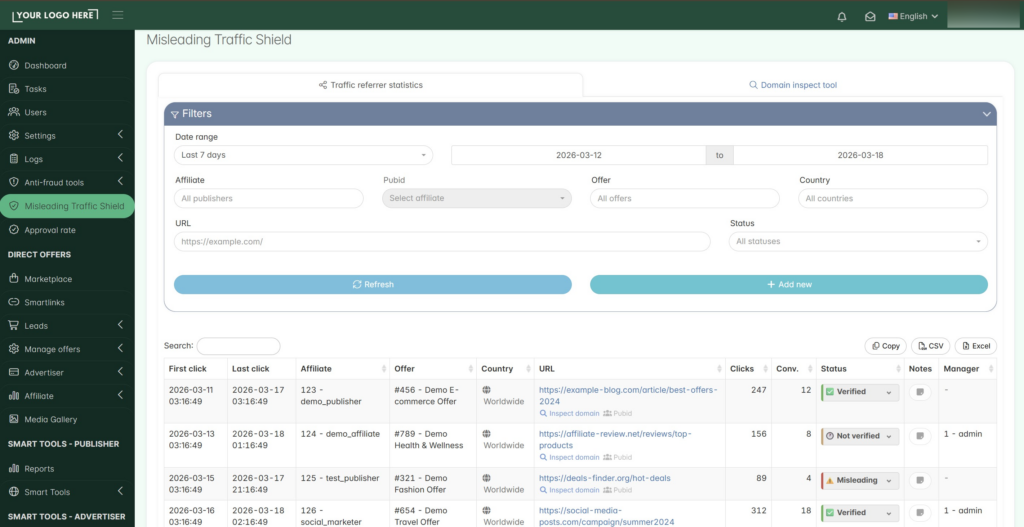
Thanks to the features our platform offers, which provide greater visibility and transparency over your affiliates’ traffic sources, you can first discourage unfair affiliates from using misleading practices, because they know that you now have visibility into their marketing funnel. Second, if someone still tries their luck, you will be able to spot it in real time, enforce compliance, or remove those affiliates altogether.
JUST TO BE CLEAR:
Not all affiliates are fraudsters or use misleading techniques. However, in the lead generation industry, especially in e-commerce and Cash on Delivery (COD) “world” there is a significant segment that does.
Since many advertisers and networks either had no way to monitor this or chose to turn a blind eye in the past for short-term profits, affiliates who adopted even partial misleading practices have grown exponentially.
Affiliate marketing in COD is not as profitable as it used to be a few years ago, exactly for this reason.
It has become a cat-and-mouse game.
It can still be profitable if you play it right, but if you try to do things properly as an honest affiliate, misleading practices from other affiliates will damage a product’s reputation most of the times before you even finish optimizing your campaigns and reaching the right audience that would actually convert.
This is how even honest affiliates are sometimes “forced” to use certain misleading techniques; otherwise, they often end up making only a small profit or merely breaking even on their traffic investment—which, in practice, means they might as well get a job instead.
How do we know this? Besides listening to our clients complain about this “trend,” we have also spoken with dozens, if not hundreds, of affiliates working on our clients’ platforms about this issue since 2023, when we started organizing an event in Italy dedicated to this industry (AffiliateExpo.it). All the stories behind the reasons for using misleading practices have these exact reasons in common.
Ok, but how can our Misleading Traffic Shield actually help you solve the problem?
As mentioned before, it first prevents issues by discouraging misleading behavior through full visibility into your affiliates’ marketing funnels. Affiliates know you now have a way to monitor them, so they are far more likely to comply—and if they don’t, you will be able to stop them in real time.
This feature has already been released to many of our clients, and the results have been amazing.
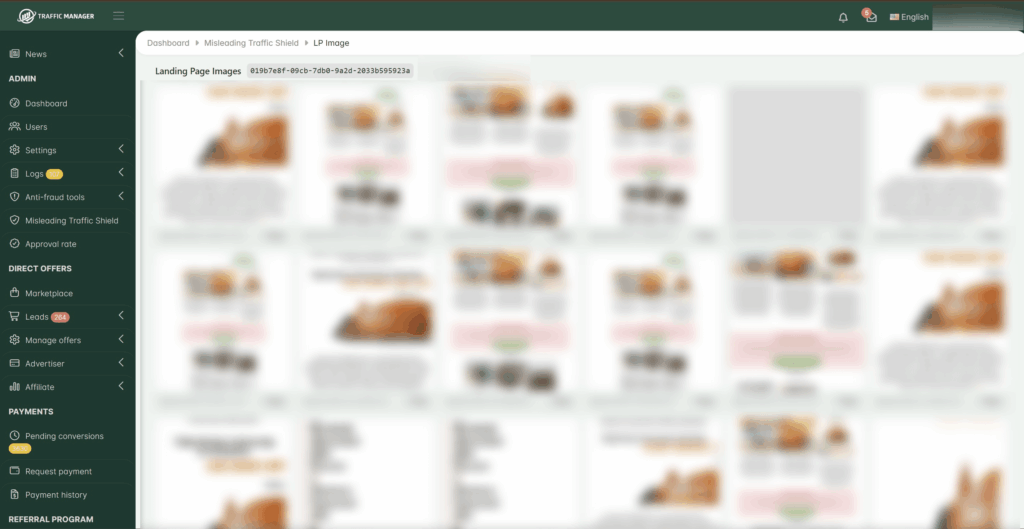
Once activated in your TrafficManager platform, affiliates are required to send leads/conversions using our unique fingerprint data. As soon as the data starts flowing in, you will be able to see all the landing pages affiliates are using to generate conversions.
And not just any random landing page they choose to show you, you will see the actual page that convinced the customer to place the order. Otherwise, the conversion will not be triggered, or you will clearly see that the fingerprint is missing.
This tool allows you to run a full, real-time scan of your sales. You can filter by affiliate, by offer (product), or by time frame, and access advanced data collected through our fingerprint system, including traffic source, landing page URL, and securely stored screenshots.
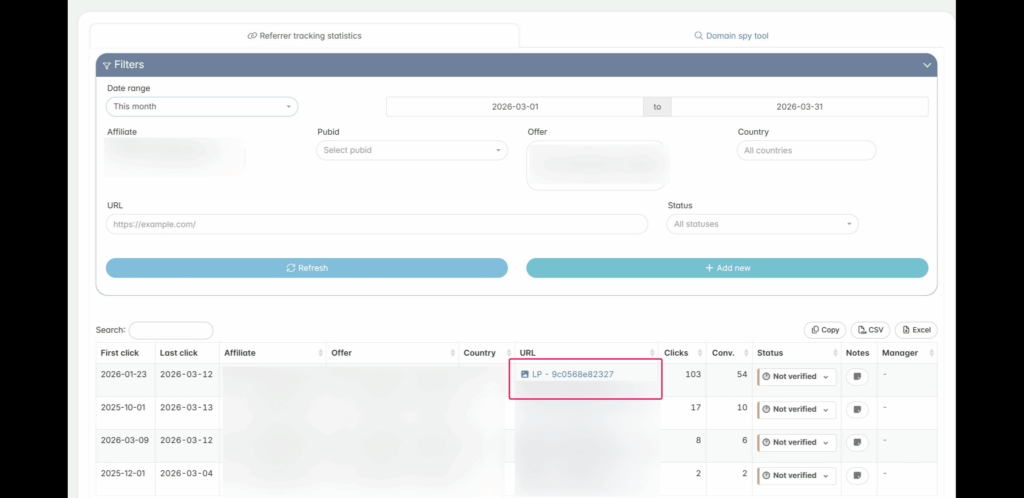
From now on, advertisers and affiliate networks using TrafficManager can finally verify whether affiliate funnels comply with their terms and conditions.
No more guessing. You will be able to see:
- what product images were used
- what claims were made
- what timers or urgency tactics were used
- what the final user actually saw before placing the order
What Happened During Beta Testing
We gave access to this feature to a few clients during beta testing and monitored the results together, then started asking questions. Something interesting happened.
Affiliate behavior changed drastically.
Once affiliates knew their landing pages could be verified, misleading funnels started to disappear. Instead of pushing fake claims to increase conversions, affiliates focused more on improving traffic quality.
At first, some affiliates protested, of course, because they feared that the advertiser would “steal” their marketing funnel ideas and angles. The advertiser made it clear to the more vocal affiliates that there was no turning back—especially since he had been losing money for months due to the high rate of refused orders at the door.
He asked for the affiliates’ trust, just as he had trusted them to sell his products blindly over the past months. He also increased affiliate payouts to encourage them to give it a try.
Some affiliates disagreed and chose to leave; they didn’t want to comply (we can make an educated guess as to why). However, those who stayed embraced both the change and the payout increase and continued to actively promote the offers.
The client initially started receiving fewer leads, but the quality increased significantly. Operational costs dropped by almost 30% from the first week, mainly because the number of bad orders decreased dramatically.
At the same time, the total number of successfully delivered orders (not just shipped) remained almost the same. Fewer low-quality leads and more real customers.
At this point, the advertiser is slowly scaling the entire infrastructure, but in a much more “healthy” controlled environment.
Mediabuyers or mediabuy teams using TrafficManager, we have news for you as well.
Your data and marketing funnels are completely safe when working with any advertiser or affiliate network using TrafficManager.
While affiliates, networks or mediabuyers working with 3rd-party tracking platforms will need to expose their direct landing page URLs when using our fingerprint (so that we can protect our clients from fraud and misleading traffic), affiliates or mediabuyers using TrafficManager do not need to do this, because we, TrafficManager, act as a guarantor for the data we share with the advertisers you work with.
This means that this feature will not expose ANY sensitive data between TrafficManager clients. No one will see your landing page URLs or any data that could lead anyone to your affiliates.
Protecting our clients’ data, privacy, and business assets is one of our top priorities.
Instead, what the TrafficManager clients you work with will see is a secure screenshot of the landing page(s) that generated the sale(s). This allows them to check whether the landing pages affiliates are using comply with their terms and conditions, without revealing sensitive information that could be misused or expose your affiliate program assets, such as final landing pages or ad creatives used for promotion.
In other words, networks and advertisers can verify what happened without exposing private campaign infrastructure.
Why We Built This Feature
Our goal is to create a secure way for TrafficManager clients to collaborate while preventing any type of unfair use of this data. This helps all participants benefit from higher-quality traffic and increased revenue, while their assets and affiliate details remain protected by us.
Affiliate marketing works best when everyone plays fair.
Advertisers need visibility. Networks need control. Affiliates and mediabuyers need clear rules, great tools, and asset protection. This is our way of bringing a bit more secured transparency into an industry where misleading traffic can destroy entire businesses.
And this is only the beginning because 70% (or more) of the Cash on Delivery (COD) affiliate programs in the entire Europe use TrafficManager to manage their business, and their business security and profitability keep our business secure and profitable.
We can extend this system further and add more protection for our clients in the future so please follow us on social media if you want to stay in touch
I am a TrafficManager client and I would like to try this feature.
If you are not sure whether this feature could help your business, you can request a 7-day free trial by opening a support ticket HERE